10-Me100fun
STEM DIY - Moon phase observation equipment
STEM DIY - Moon phase observation equipment
Couldn't load pickup availability
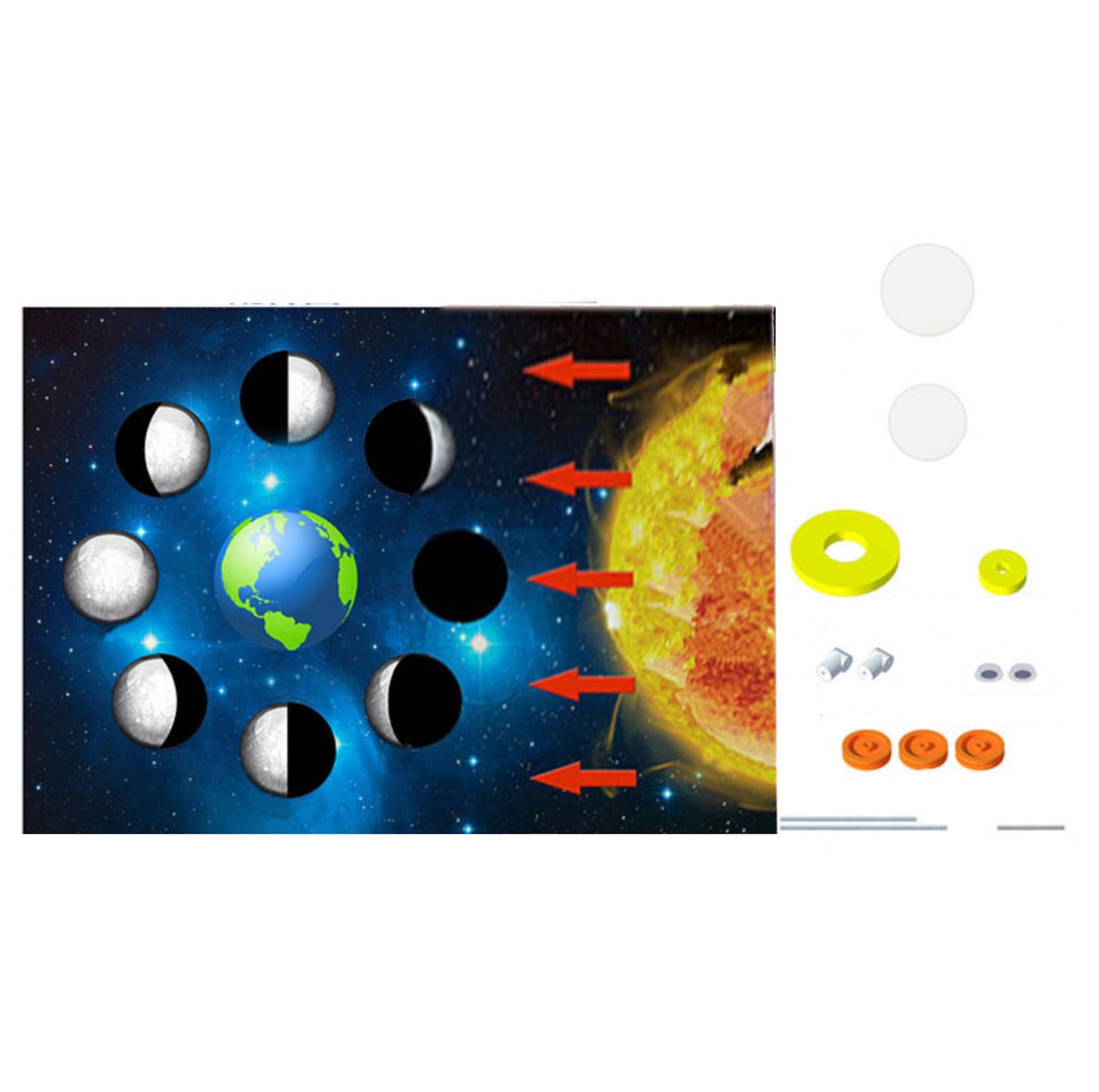
Simulation of Moon Phase Formation
【Objectives】
1. To gain a preliminary understanding of the causes of moon phases and foster spatial imagination.
2. To cultivate students' practical abilities.
[Preparation] Equipment: A ball with a diameter of about 35cm to represent the Moon. A 30cm ball to represent the Sun.
There are two causes of the Moon's phases:
1. The Moon itself is neither luminous nor transparent, but it can reflect sunlight.
2. The relative positions of the Sun, Earth, and Moon are constantly changing, so the illuminated part of the Moon as seen by observers on Earth is constantly changing, resulting in different apparent shapes.
[Activity Process] Place a designed moon phase demonstration map on the table, with the Earth in the middle and the Moon's orbit on both sides. The student in the center assumes they are standing at the North Pole, and another student holds the moon model and circles it counter-clockwise (Note: during the "Moon's orbit", its illuminated hemisphere must always face the direction assumed by the Sun's rays). Then the student in the center can observe the change of the Moon's phases.
Related Information:
New Moon (the first day of the lunar calendar, facing the Sun) 0 degrees
Waxing Crescent (usually from the second night to the seventh day of the lunar calendar) 90 degrees
First Quarter Moon (around the 8th day of the first lunar month) 90 degrees
Waxing Gibbous (ninth to fourteenth day of the first lunar month) 90 degrees to 180 degrees
Full Moon (opposite the Sun, around the 15th or 16th day of the lunar calendar) 180 degrees
Waning Gibbous (16th lunar calendar to 23rd lunar calendar) 180 degrees to 270 degrees
Last Quarter Moon (around the 23rd day of the lunar calendar) 270 degrees
Waning Crescent (around the 24th day of the lunar calendar to the end of the month) 270 degrees to 360 degrees
分享